This electric three wheeler guide explains vehicle types, LFP battery technology, real-world range, running-cost savings, and how fleet operators in Africa, South America, and Southeast Asia choose the right model.
A tuk tuk driver in Nairobi spends roughly a third of every day's earnings on petrol. Swap the engine for a battery and that number can drop by two-thirds. That single shift is why more than 60% of three-wheelers now sold in India are electric, and why fleet buyers from Lima to Manila are asking the same question in 2026: is it time to go electric?
The answer depends on your route length, local electricity price, and charging access. This electric three wheeler guide walks through every decision a serious buyer faces, using real specifications from Wanhoo's EV line and honest numbers on where electric wins and where it still asks for patience.
How big is the electric three-wheeler market in 2026?
The electric three-wheeler market crossed a real tipping point in the mid-2020s, moving from niche experiment to mainstream fleet choice. Global electric three-wheeler sales grew more than 10% in 2024 to surpass one million vehicles, representing almost one-quarter of all three-wheeler sales worldwide, up from one-fifth the year before, even as the overall three-wheeler market shrank. The trajectory points one direction.
According to the International Council on Clean Transportation, India led the world with 57% of global electric three-wheeler sales in 2024, proving the model works at scale in developing-economy conditions. That matters for African and Southeast Asian buyers, because India's roads, climate, and duty cycles mirror their own far more closely than Europe's do.
An electric three wheeler is a three-wheeled motor vehicle powered by an electric motor and rechargeable battery instead of a combustion engine, built for passenger transport or cargo hauling in urban and last-mile conditions. It produces zero tailpipe emissions and typically runs at 30% to 70% of the operating cost of a comparable petrol model, depending on local fuel and electricity prices.
According to Business Standard, citing the IEA, India remained the largest electric three-wheeler market for a second straight year as sales rose about 20% to roughly 700,000 vehicles. Policy support like FAME-II and the newer PM E-Drive scheme lowered upfront costs enough to make electric price-competitive with petrol, a lever many other markets are now copying.
What types of electric three-wheelers are there?
Electric three-wheelers split into two families defined by what they carry: passengers or cargo. Getting this choice right is the single most important decision, because chassis, seating, suspension, and battery sizing all follow from it. Buying a passenger frame for cargo duty, or the reverse, wastes payload and shortens vehicle life.
An electric passenger tricycle carries fare-paying riders in an enclosed or semi-enclosed cabin, optimized for comfort, safety, and quick stop-start city cycles. An electric cargo tricycle trades seats for a load bed or box, optimized for payload, low-speed torque, and durability under heavy daily weight. The table below maps the main electric three wheeler categories a buyer will compare.
| Type | Primary use | Typical capacity | Best-fit buyer |
|---|---|---|---|
| Electric passenger tricycle | Taxi / tuk tuk fleets | 3 passengers | City taxi operators, resorts |
| Heavy-duty electric passenger | Shuttle / mini-bus routes | 6-9 passengers | Transit, campus, tourism |
| Electric cargo tricycle | Last-mile delivery | 300-800 kg | E-commerce, distribution |
| Electric utility tricycle | Municipal / campus service | Mixed | Governments, institutions |
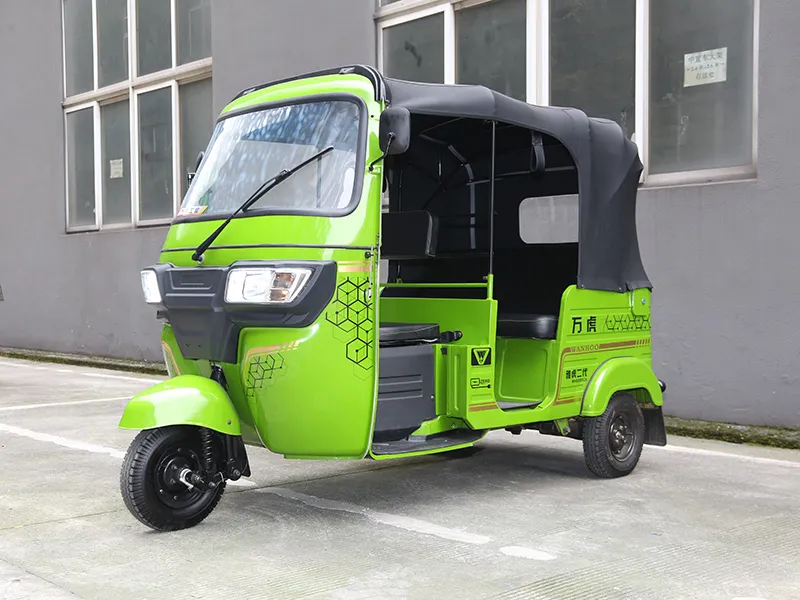
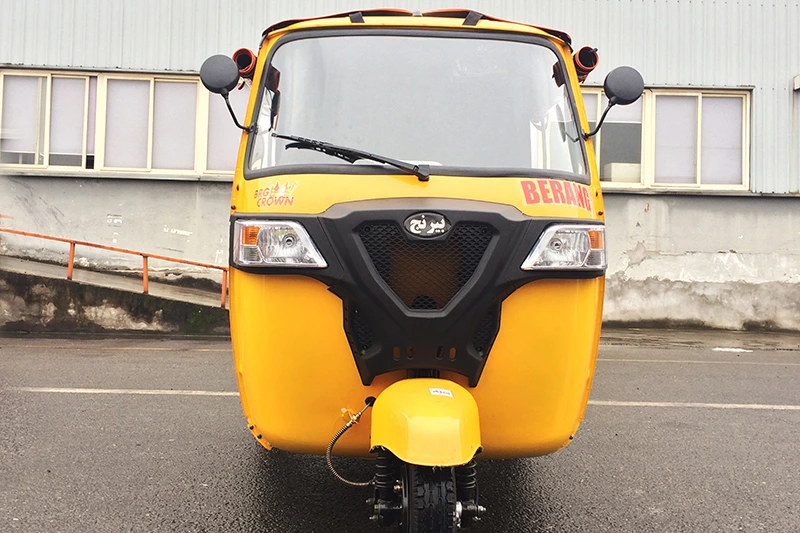
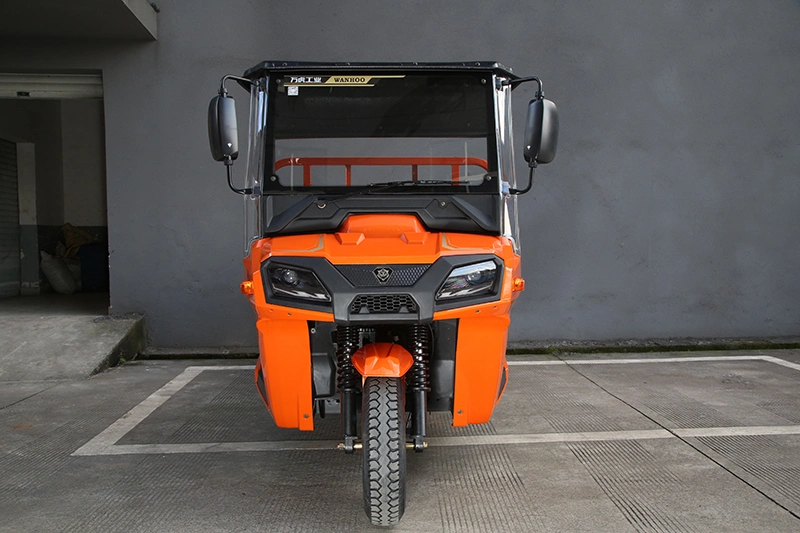
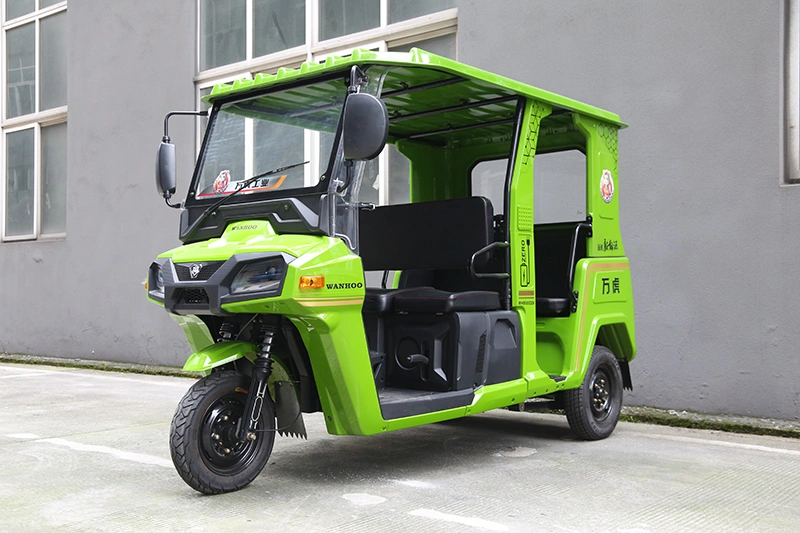
Wanhoo builds two dedicated electric passenger platforms: the YAHOO-II-Electric, a three-passenger tuk tuk for city taxi fleets, and the King-Tiger-Electric, a nine-seat heavy-duty tricycle for shuttle and transit routes. Both use LFP batteries and a 72-volt system, and both ship FOB without the battery pack.
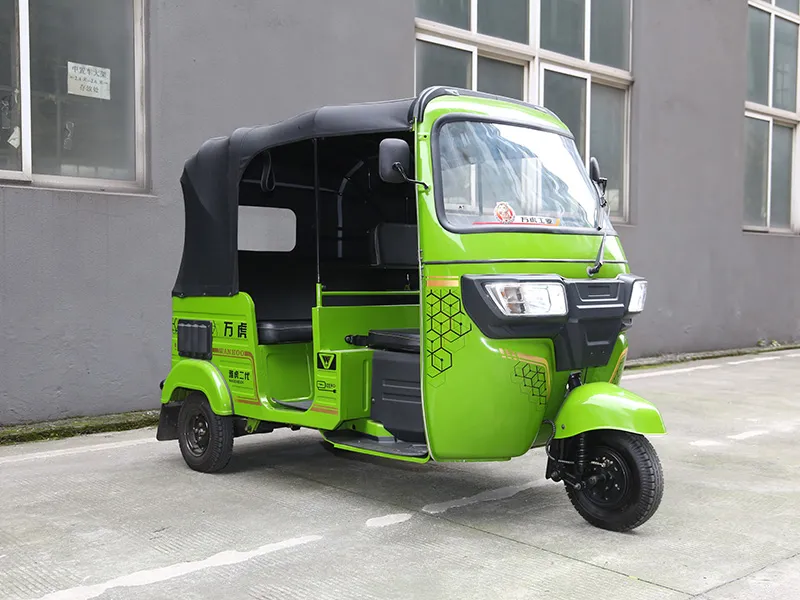
Wanhoo's YAHOO-II-Electric pairs a 5,000-watt motor with an 80 to 100 km range, making it a direct electric replacement for the petrol tuk tuks that dominate African and Southeast Asian taxi work. The heavier King-Tiger-Electric applies Wanhoo's load-rated chassis, first proven under cargo duty, to clean nine-passenger transit where noise and emission rules increasingly restrict diesel shuttles.
Why does LFP battery chemistry matter for three-wheelers?
Battery chemistry decides how long a vehicle lasts, how safe it is in heat, and how much it costs to run over years, not months. For three-wheelers working full days in tropical climates, this is not a technical footnote. The wrong chemistry degrades fast, risks fire, and turns a cheap upfront price into an expensive replacement cycle.
An LFP battery (lithium iron phosphate, or LiFePO4) is a lithium-ion chemistry that uses an iron-phosphate cathode, prized for thermal stability, long cycle life, and safety, with no cobalt or nickel content. Its olivine crystal structure resists breaking down under heat and does not readily release oxygen, the fuel that drives battery fires in other chemistries.
According to Wikipedia's technical reference on lithium iron phosphate batteries, LFP cells support more than 3,000 charge cycles, compared with roughly 1,000 to 2,300 for NMC, and offer higher decomposition temperatures without releasing oxygen when heated. Independent testing has shown LFP cells peaking near 297 degrees Celsius during thermal runaway, while nickel-rich NMC cells in the same failure conditions exceeded 860 degrees Celsius, a safety gap that matters in hot-climate fleet operation.
Wanhoo standardized its entire EV line on LFP for exactly these reasons: 2,000-plus real-world charge cycles, strong performance in heat, and no dependence on scarce, price-volatile cobalt. The comparison below shows why LFP beats the two common alternatives for hardworking three-wheelers.
| Chemistry | Cycle life | Heat safety | Relative cost | Fleet verdict |
|---|---|---|---|---|
| LFP (lithium iron phosphate) | 2,000-3,000+ | Excellent | Moderate | Best for daily heavy use |
| Lead-acid | 300-500 | Fair | Lowest | Cheap upfront, short life |
| NMC (nickel manganese cobalt) | 1,000-2,300 | Lower | Highest | Higher range, higher risk |
Lead-acid remains cheaper on day one, but its 300 to 500 cycle life means replacement every year or two under fleet use, erasing the savings. LFP's longer life and heat tolerance make it the chemistry that actually lowers cost per kilometer across a vehicle's working years.
What are the real range and charging limits?
Range and charging are where electric three-wheelers earn honest scrutiny, because they set the boundary of what routes work today. A petrol tuk tuk refuels in three minutes and runs all day; an electric one needs planning. For fixed urban loops the math already works, but long rural routes without charging infrastructure still favor combustion.
Wanhoo's YAHOO-II-Electric delivers an 80 to 100 km range per charge on its 72V 150AH LFP pack, recharging in 7.5 hours on a 25-amp charger or 3.5 hours on a 50-amp fast charger. The King-Tiger-Electric offers a 72V 120AH pack that recharges in about 5.5 hours, suited to shuttle routes returning to a depot.
For a city taxi covering 60 to 90 km per shift, that range comfortably clears a full working day with an overnight charge. The realistic model is depot or home charging during off-hours, not roadside top-ups. Operators running two shifts should size battery capacity or swap packs, since a single charge rarely covers 18 hours of continuous city work.
Charging dependency is the genuine constraint buyers must respect. Where grid power is unreliable or absent, electric three-wheelers demand solar charging, battery swapping, or a generator backup, each adding cost and complexity. This is why route length and charging access, not price alone, should drive the buy decision, a theme covered further in the electric three-wheeler category overview.
How much does an electric three-wheeler really save?
Running-cost savings are the core reason fleets switch, and the numbers are large enough to reshape a driver's economics. Fuel is the single biggest daily expense for a petrol three-wheeler operator, so replacing it with electricity attacks the cost base directly. The savings compound every day the vehicle works.
According to GreenCape's 2024 South African EV market report, an electric three-wheeler uses about R9.20 of energy per 100 km versus R57.36 for an ICE motorcycle in last-mile delivery, an operational energy-cost saving above 80%. At 36,500 km per year, the report also finds the electric micro-vehicle's combined capital and operating cost lower over eight years than the ICE alternative. In GreenCape's South African last-mile model, the electric three-wheeler cuts energy cost by more than 80% and delivers a lower eight-year combined CAPEX and OPEX than the combustion alternative at commercial mileage.
Wanhoo positions its EV line on up to roughly 70% lower operating cost versus comparable petrol tuk tuks, the figure that most directly moves fleet buyers. On a vehicle covering 80 km a day, six days a week, saved fuel alone can offset the battery investment within the first years of service. The full payback math, including upfront price, battery, and maintenance, is broken down in the deep-dive on electric tuk tuk versus gasoline cost.
Honesty matters here: the upfront cost is higher, especially once the battery is added, and Wanhoo's FOB pricing is quoted without battery precisely so buyers can source cells locally or negotiate a battery-included quote. Electric wins on total cost of ownership over years, not on the first invoice, and only when charging is available.
How do government EV policies affect the decision?
Government policy is quietly the biggest accelerator of electric three-wheeler adoption, because it attacks the one weakness: upfront price. Subsidies, tax breaks, and low-emission zones tilt the math toward electric and, in some cities, make petrol three-wheelers harder to license or operate. Buyers who ignore local policy leave money and market access on the table.
India's FAME-II and PM E-Drive schemes are the clearest proof, cutting purchase prices enough to push electric past 60% of new three-wheeler sales there. Across Southeast Asian cities, tightening emission rules and urban vehicle restrictions are pushing operators toward zero-emission three-wheelers, since electric models sidestep the low-emission-zone limits and fuel taxes increasingly applied to petrol and diesel fleets. Similar incentives are emerging across African and South American markets.
Wanhoo's zero-emission EV line, the YAHOO-II-Electric and King-Tiger-Electric, is built to qualify under exactly these green-procurement and emission-zone frameworks, giving buyers a compliant option as rules tighten. For government and institutional buyers running municipal or campus fleets, an electric three-wheeler often unlocks grants or preferential purchasing that petrol equivalents cannot access.
The practical step is to check three things before buying: local purchase subsidies, any low-emission zone rules in your operating cities, and electricity tariff levels. Together these determine whether electric is already the cheaper choice in your market or a smart bet on where regulation is heading.
Frequently Asked Questions
**What is the range of an electric three-wheeler?**
Most electric passenger three-wheelers deliver 80 to 120 km per charge, enough for a full city taxi shift. Wanhoo’s YAHOO-II-Electric covers 80 to 100 km on its 72V 150AH LFP battery, recharging overnight in 7.5 hours on a standard charger or 3.5 hours with fast charging.
Why do electric three-wheelers use LFP batteries instead of lead-acid?
LFP (lithium iron phosphate) batteries last 2,000 or more charge cycles versus 300 to 500 for lead-acid, tolerate heat far better, and hold up under daily fleet use. Lead-acid is cheaper upfront but needs replacing every year or two, which erases the initial savings over a vehicle's working life.
How much cheaper is an electric three-wheeler to run than petrol?
Electric three-wheelers typically cut running costs by 60% to 70% because electricity is far cheaper per kilometer than petrol. Wanhoo positions its EV line at up to roughly 70% lower operating cost. The saving grows over time, since electricity tariffs stay more stable than volatile fuel prices.
Does the FOB price of a Wanhoo electric three-wheeler include the battery?
No. Wanhoo quotes EV models FOB without the battery, so the YAHOO-II-Electric starts at $1,670 and the King-Tiger-Electric at $1,560, both battery-excluded. This lets buyers source cells locally or request a battery-included quote, and it keeps freight and customs simpler for many markets.
Can an electric three-wheeler work without reliable grid power?
Yes, but it requires planning. Where the grid is unreliable, operators pair electric three-wheelers with solar charging, battery swapping, or generator backup. Route length and charging access, not just price, should drive the decision, since fixed urban loops with depot charging suit electric far better than long rural routes.
Should I buy an electric passenger or electric cargo tricycle?
Choose by what you carry. An electric passenger tricycle, like the YAHOO-II-Electric, is built for fare-paying riders with a comfortable cabin and city stop-start duty. An electric cargo tricycle is built for payload with a load bed and low-speed torque. Matching the vehicle family to your work protects payload and vehicle life.